
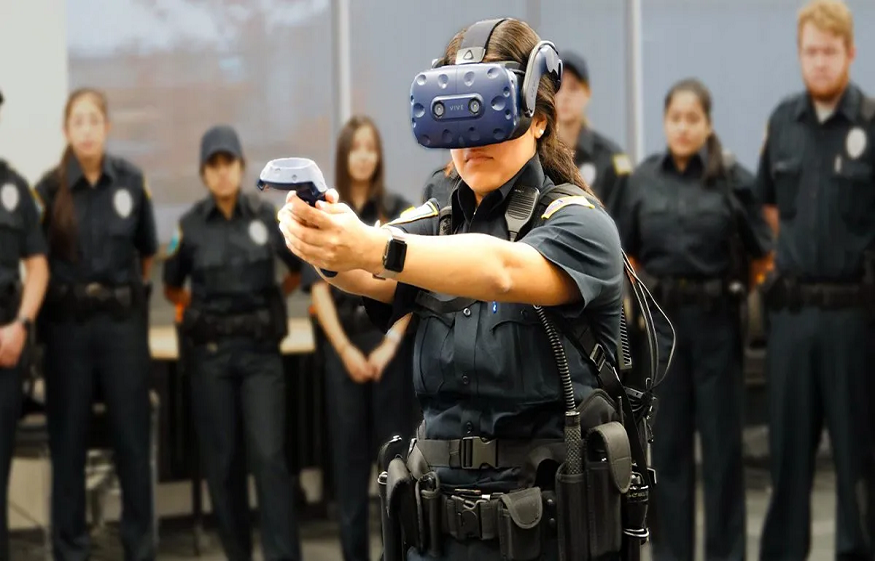

Law enforcement officers regularly encounter situations where decisions must be made within seconds. From managing public disturbances and responding to emergencies to communicating with distressed individuals, officers need to remain focused and composed even when circumstances become unpredictable. Therefore, today a police academy VR training simulator is often used to prepare law enforcement trainees for these demanding situations through immersive, realistic, and repeatable simulations.
Why use police academy VR training simulator to prepare law enforcement officers
Unlike conventional training methods that may depend on physical locations, role players, vehicles, equipment, and controlled exercises, police academy VR training simulator allow officers to enter simulated environments designed around real-world challenges. They can rehearse tactical responses, communication techniques, situational awareness, teamwork, and decision-making without being exposed to the physical dangers associated with live training exercises.
Modern policing involves far more than learning standard procedures. Officers frequently interact with people from different backgrounds and must respond appropriately to situations involving confusion, fear, aggression, mental distress, emergencies, or rapidly changing circumstances. Traditional classroom instruction can explain what an officer should do, but it cannot always recreate the pressure and uncertainty of an actual encounter. VR training addresses this gap by placing officers inside interactive scenarios where their actions influence how the situation develops. An officer may need to assess a potentially dangerous environment, communicate with a person, coordinate with another officer, or determine when a situation requires a tactical response. Repeated exposure to these scenarios can help personnel become more comfortable making decisions under pressure. Instead of simply memorizing procedures, officers have an opportunity to apply their knowledge in an environment designed to simulate the challenges of field situations.
Read More: TOP 6 TYPES OF PAINTING TO SPRUCE-UP YOUR HOME DÉCOR
One of the major advantages of immersive law enforcement training is its ability to focus on decision-making rather than simple information retention. Officers can encounter situations where there is no obvious or immediate answer. They must observe their surroundings, interpret behavior, communicate effectively, and determine an appropriate course of action. A police academy VR training simulator can recreate these circumstances without putting participants or members of the public at risk. If an officer makes an inappropriate decision during a scenario, instructors can review the event and use it as a learning opportunity. The exercise can then be repeated so the officer can explore a different response. This creates a valuable cycle of practice, evaluation, feedback, and improvement.
Traditional simulation exercises can require substantial resources. Departments may need dedicated training grounds, vehicles, physical props, specialized equipment, instructors, travel arrangements, and extensive preparation. VR can reduce the need for some of these physical resources. Once the necessary technology and software are available, departments can run numerous scenarios without rebuilding a physical environment for every exercise. The financial benefits can extend beyond equipment. Virtual simulations can reduce logistical requirements and make it easier to provide recurring training without organizing large-scale physical exercises each time.
Read More: AN ELEVATED ADVENTURE BETWEEN EARTH AND HEAVEN
Safety remains one of the most important considerations in law enforcement education. Officers need realistic practice, but training should not expose participants to unnecessary physical hazards. VR creates a controlled environment in which officers can experience demanding scenarios without the same physical risks associated with live exercises. Complex situations can be practiced repeatedly, allowing participants to build familiarity and confidence.